
观点:我坚持我之前关于重新思考北约的帖子。
先说清楚,我热爱欧洲。它大概是地球上最美丽、最有趣的地方。我去过的每一个欧洲国家我都喜欢。法国差一点。但他们确实很努力地保持这种“与众不同”。
客套话说完了,我上一篇关于这个话题的帖子,让我莫名其妙多了一个我自己都不知道存在的 Threads 账号——拜 Meta 所赐。那里的回复可以说是“很有意思”。清一色极左、匿名、情绪失控又充满优越感。看来在他们把那个平台搞砸之后,欧洲那些 Blue Sky 的粉丝都跑到这儿来了。
我们来谈谈美欧关系的历史。先从一个事实说起:两次世界大战都是他们引发的,而我们不得不出手收拾残局。此后,我们又通过马歇尔计划以及参与北约,一直在为此买单。
马歇尔计划在二战后重建欧洲,花费了美国纳税人132亿美元,按今天的价值约为1700亿美元。
自1949年北约成立以来,美国为联盟防务预算贡献了21.9万亿美元。
在同一时期,欧洲北约成员总共大约贡献了9万亿美元。
也就是说,美国为欧洲防务支付的费用大约是欧洲自己的2.4倍。
所以,总结一下:我们帮他们避免了两次“说德语”,一次“说俄语”。他们最好记住这一点。
现在谈谈当前的冲突。
坦率说,考虑到我们事先既没有通知他们,也没有请求他们协助,我并不责怪欧洲国家或北约没有支持我们的行动。而且,北约本来就是一个防御性联盟。
不过,我对一些国家决定对我们关闭领空、拒绝我们使用那些由我们出资、在大多数情况下还是我们建造的空军基地,并不感到满意。
但我更大的抱怨是:即便他们想帮,也帮不上。
事实是,他们的军队训练不足,装备严重短缺且大多过时,空军基本形同虚设,海军多数还没到战区可能就先沉了。听起来很刺耳,但下面是“事实”。
陆地方面:
法国的弹药储备在真实战斗中只能撑两周。乌克兰一天发射的炮弹比法国一个月生产的还多。西班牙决定自研装甲运兵车,结果晚了12年才交付,而且他们造的127辆一辆都用不了。德国士兵参加北约演习时,因为步枪不够,只好拿刷成黑色的扫帚充数。
空中方面:
德国有128架“台风”战机,其中只有4架具备作战能力。英国有40名F-35飞行员、37架战机,其中12架可作战。比利时曾让整个F-16机队停飞,不得不请求荷兰来保护其领空。
海上方面:
英国花了80亿美元建造两艘航母,却无法长期出海。西班牙造了一艘潜艇,重到无法上浮。挪威一艘护卫舰因为把油轮误认为港口而撞沉。
这些例子是不是断章取义?当然是。
但可以证明的是:2014年,欧洲北约成员在承诺将国防开支提高到GDP的2%时,实际只投入了1.43%。在俄罗斯重建军力、伊朗推进核计划的十年间,他们一直低于这个标准。直到2024年,在俄罗斯入侵乌克兰、形势所迫之后,他们才终于超过2%,整整晚了十年。
这就是疏忽。
再来说“搭便车”。
所谓搭便车,就是在没有承担相应成本的情况下获得收益。从战略角度看,就是让他人承担公共产品的风险与费用,而把自己的资源转移到其他地方。
在这里,这个“公共产品”就是欧洲的安全。而自1945年以来,这一直由美国提供。
欧洲整体上喜欢对美国嗤之以鼻,还炫耀他们世界一流的社会福利体系。
但现实是,这些福利,很大程度上是我们美国人替他们买单。
数据说明一切。
美国人平均每年工作1796小时。德国人平均1354小时。法国人大约1500小时。美国人每年比西欧同行多工作大约400到450小时。
社会保障体系对比:
德国提供全民医疗、免费大学教育和慷慨的失业福利。法国也是如此。欧洲社会支出占GDP的平均比例在25%到30%之间,美国约为18%。
工作时长对比:
法国法律规定每周标准工时为35小时,实际平均为30.7小时。荷兰平均每周26.7小时。40%的美国人每周工作41到50小时。
带薪休假对比:
欧洲包括公共假日在内的最低带薪假期平均为每年33天。美国是唯一一个没有法定带薪假的发达经济体。美国人平均每年休假14天,欧洲人平均24天。
大学教育成本对比:
德国公立大学对所有学生(包括美国人)免费。法国对欧盟公民每年收费约182美元。欧洲英语授课本科平均每年约7390美元。美国州内公立大学四年平均总费用为每年25707美元,私立大学平均为54501美元。
这些项目对欧洲生活水平的整体提升,难以估量。
再用他们自己的数据收尾:
一项2024年的欧洲学术研究记录了经济学家所谓的“和平红利”,即欧洲政府将原本用于国防的资金转用于福利国家扩张。
1990年至2023年间,德国每年腾出超过200亿欧元的预算空间。西班牙超过100亿,意大利超过80亿——年复一年,持续数十年。
与此同时,美国纳税人为他们承担了防务开支。传统基金会的分析认为,仅自2014年以来,欧洲北约国家的国防支出缺口就达到8270亿美元。不是欧洲建立了福利国家,而是美国替他们建立了。
所以下次当某个来自欧洲的左翼激进分子谈论他们“优越”的社会福利时,拿出这些事实,让他们低头,向你致意——因为这些是你在为他们买单。
这应该让每一个美国人愤怒。
有人反驳说,我们从这种关系中获得了重大收益:第一,这是以低成本在欧洲投射力量或实现力量倍增;第二,确保欧洲这些人不会重新武装到再次引发世界大战,就像前两次那样。
我不确定这是否值得。而且既然我明确支持我们对伊朗的打击行动,我也该为“美国优先”阵营和我的孩子们要回一些钱。我认为,审视我们与北约的关系,是一个很好的起点。
我不想要情绪化的反应。我想要纸上计算、冷静分析。让我们逐个国家核算投资回报率,看看结果如何。
大多数国家可能都过不了关。
——HVH
OPINION: I am doubling down on my previous post about rethinking NATO.
To be clear, I love Europe. It's probably the most beautiful and interesting place on Earth. I have never been to a European country I didn't like. France is close. But they work hard to maintain that distinction.
Now that we have the short pleasantries out of the way, my last post on the subject landed me in a threads account that I didn't even know I had, courtesy of Meta. The replies were "interesting" to say the least. 100% far left, faceless, emotionally unhinged and entitled. This must be where all the European Blue Sky fans went after they cratered that platform.
Let's talk about the history of the US-European relationship starting with the fact that we had to bail them out of two world wars that they started and that we've been paying for ever since by virtue of the Marshall Plan and by virtue of our involvement in NATO.
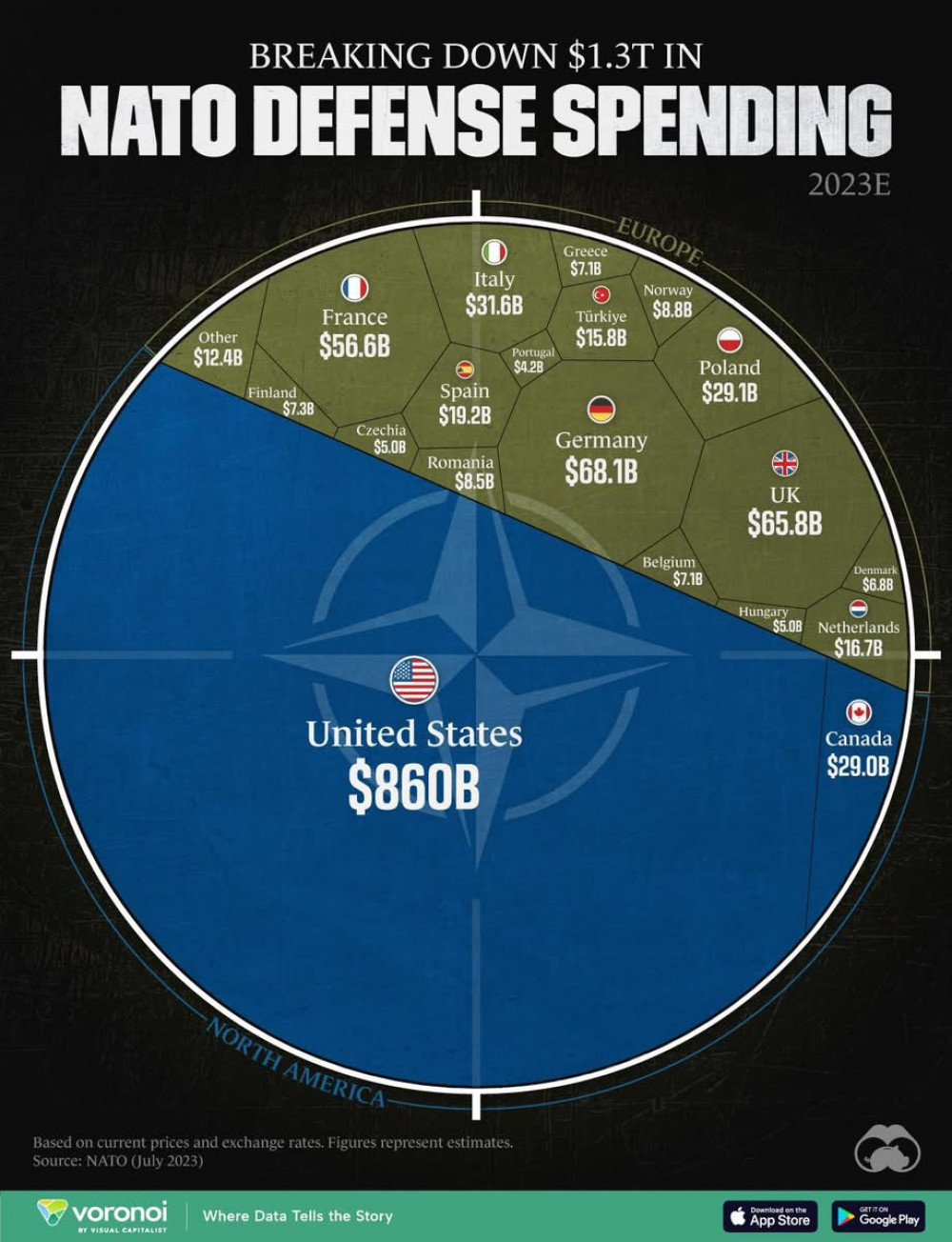
The Marshall Plan, that rebuilt Europe after World War II, cost American taxpayers $13.2 billion, roughly $170 billion in today's dollars.
Since NATO's founding in 1949, the United States has contributed $21.9 trillion to the alliance's defense budget.
Over that same period, European NATO members collectively contributed approximately $9 trillion.
The United States has therefore paid approximately 2.4 times more for European defense than Europe has.
So for those keeping track, that's two times not speaking German and one time not speaking Russian. They should keep that in mind.
Now let's talk about the current conflict.
Frankly, I don't blame the European countries or NATO for not supporting our effort, considering we did not notify them or request their assistance in advance. Also, it’s a defensive alliance.
However, I am not thrilled that several countries have decided to close their airspace to us and deny access to our airbases that we pay for and in most cases we built.
But my bigger complaint is that none of them could help us if they wanted to.
The fact is that their militaries are poorly trained, their equipment is sorely missing and substantially out of date, their air forces are largely nonexistent, and most of their navy would sink before they got into the theater. That sounds harsh, but here come the facts.
On the ground:
French ammo stocks would last two weeks in real combat. Ukraine fires more artillery shells in a day than France produces in a month. Spain decided to build their own armored personnel carrier. It arrived 12 years late and out of the 127 they built none of them worked. German soldiers showed up to a NATO exercise with broomsticks painted black because they didn't have enough rifles.
In the air:
Germany has 128 Eurofighters. Four are combat ready. Britain has 40 F-35 pilots, 37 jets, 12 combat ready. Belgium grounded its entire F-16 fleet and had to ask the Netherlands to protect Belgian airspace.
At sea:
Britain spent $8 billion on two carriers that can't stay at sea. Spain built a submarine so heavy it could never resurface. A Norwegian frigate sank after its crew mistook an oil tanker for a harbor.
Are these facts cherry picked? Absolutely!
But what is demonstrable is that European NATO members spent just 1.43% of their combined GDP on defense in 2014, the year they pledged to hit 2%. They spent a decade below that threshold while Russia rebuilt its military and Iran advanced its nuclear program. They only crossed 2% in 2024, a full ten years late, and only after Russia invaded Ukraine and forced their hand.
That is neglect.
Now let's talk about Freeloading.
Freeloading is defined simply as receiving a benefit without paying a proportionate share of its cost. In strategic terms it means allowing another party to absorb the risk and expense of a public good while redirecting your own resources elsewhere.
In this case the public good is European security. The United States has provided it continuously since 1945.
Europe collectively loves to look down their nose at the US and brag about their world-class social programs.
But the reality is, it's you and I here in the United States that have been paying for those benefits.
The statistics tell the story.
The average American works 1,796 hours per year. The average German works 1,354 hours per year. The average French worker logs approximately 1,500 hours per year. Americans work roughly 400 to 450 more hours annually than their Western European counterparts.
Their social safety net versus ours.
Germany offers universal healthcare, free university tuition, and generous unemployment benefits. France offers the same. Average European social spending as a share of GDP runs between 25 and 30 percent. The US runs closer to 18 percent.
Their average work week versus ours.
France legally caps the standard work week at 35 hours with an actual average of 30.7 hours worked. The Netherlands averages 26.7 hours per week. Forty percent of Americans work 41 to 50 hours per week.
Their average number of vacation days versus ours.
Europe's average minimum paid leave including public holidays totals 33 days per year. The United States is the only advanced economy in the world with no legally required paid leave. Americans take an average of 14 days off per year. Europeans take an average of 24.
The cost of a college education there versus ours.
Public university tuition in Germany is free for all students including Americans. France charges EU citizens approximately $182 per year. The average cost of an English-taught bachelor's degree across Europe runs approximately $7,390 per year for international students. The average cost of a four-year in-state public university in the United States runs $25,707 per year. Private university tuition averages $54,501 per year.
The overall impact of these programs on European standard of living is immeasurable.
Tying it all together with their own data.
A 2024 European academic study documented what economists call the "peace dividend," money European governments redirected from defense into welfare state expansion.
Germany pocketed over €20 billion per year in freed-up budget capacity between 1990 and 2023. Spain over €10 billion. Italy over €8 billion. Annually. For decades.
Meanwhile American taxpayers covered their defense bill. The Heritage Foundation analysis puts the European NATO underspending deficit at $827 billion since 2014 alone. Europe didn't build a welfare state. America built it for them.
So the next time some left-wing lunatic from Europe starts talking about their superior social programs drop some facts on them, tell them to bend the knee, and kiss your ring because you are paying for it.
This should make every American furious.
Some of you argued that we receive a substantial benefit from this relationship in two ways, first it is a low cost projection of force or force multiplier into the European theater, and it's in our benefit to make sure that these knuckleheads in Europe don't rearm themselves to the point that they start World War III just like the last two times.
I'm not sure that's worth it. And since I support our attack in Iran definitively, I owe the America First crowd, and my children, some money back. I think investigating our NATO relationship would be a great place to start.
I don't want emotional reactions. I want pencil to paper and cold calculations. Let's start number crunching our return on investment one country at a time and see where we go from there.
Most of them won't make the cut.
- HVH
这次正好给了川普理由削减驻欧洲美军。
老川在踢他们屁股,好像这些人躺地上打滚儿撒泼装死
欧洲人躺着吃福利。跟他们谈论到美国人加班的时候, 所有的人都很鄙夷的。
大哥跟小弟们吼一声你们也要出钱出力的, 就哭爹喊娘满地打滚了。
这年头就比谁脸皮更厚更无赖。
美国人的确是勤奋,但是现在制度性养出来很多懒人和蛀虫。欧洲的福利体系的确是unsustainable 的。
这一二十年来的woke文化真的是很可怕,整个西方世界差不多彻底沉沦到污泥里而不能自拔。所幸出来一个老顽童般的川普,不晓得是不是螳臂当车。
好友的前公司在欧洲分部裁人, package是三年还是五年起。 一般人不同意被裁的话还不能强制。公司有个老人马上就要退休了, 主动要求被裁, 多拿了好几年的工资。
最好的毁掉一个人一个机构一个国家就是什么也不干,一直发钱。
升米恩斗米仇的又一次演绎。
其实当年美国是收买欧洲来对付苏联。但是现在俄国只是个地区强国,根本没能力对美国的全球秩序进行挑战。而俄国的人口出生率和经济的现状在可见的未来也只是欧洲的麻烦而不是美国的麻烦。美国就算不退出NATO,也应该大幅削减欧洲的基地而驻军,往极端方向说,俄国就算全占了乌克兰对美国也没有一丁点的威胁。
这次美国的新盟友是海湾的阿拉伯国家,而欧洲更像是恨不得你倒霉的亲戚,早分家早好。
但是他要搞欧洲诸国,让他们不得安身还是很容易的
以前是职业政治家当政,反正不是自己的钱,贴了不心疼。
现在来个老地主当家,上来先把家底儿盘个点。再拿出算盘三下五除二算算谁是最大的拖累,这一算,和尚头上的虱子。大嘴地主马上嚷出声来了。
你说的是。
这些人的是这样思考问题的:在过去的若干年以来,这个好处一直都是给我的,凭什么你一来,就给我取消掉了?
他们不会在乎这个好处是不是别人的付出、当然也就不会感激别人。
这也是我为什么,我从根本上反对一切政府包办的福利的原因。领取福利的人会认为理所当然、不会感恩任何人、当然更不会感恩纳税人。而且一旦某项福利设立,想取消?门都没有。
福利可以有,但是应该来自私营机构或个人,毕竟恻隐之心,人皆有之。但是做之前,还是应该三思而后行。
========================
从大约2009年开始(到2017年报道时已持续8年),Mamud决定做一件善事:他自掏腰包,每月给当地养老金领取者和贫困家庭发放面包券。每户符合条件的家庭可以领10张券,每张券能换1条白面包 + 半条黑面包。整个行动完全是个人慈善,没有任何政府补贴或帮助。他每月大约要发放3000条面包,费用全部自己承担。
起初这听起来很温暖,但实际情况却让店主和店员非常心寒:
- 很多领面包的人并不感激,反而把这当成“应得的权利”或政府福利。
- 当面包发完时,顾客会冲着店员大骂, accusing 他们“偷了普京的钱”“偷了市长或省长的钱”,甚至举报到相关部门。
- 店员曾哭着说:“一开始,每天顾客都把我骂到哭,这太伤人了。”
- 有人因为没多领到券,就当面用种族歧视的脏话骂店员(因为店主是亚美尼亚人)。
- 民众普遍怀疑这是某种骗局或贪污行为,不相信有人会真心自费做好事。
尽管面临这些不满、压力和不领情,Mamud 当时还是坚持继续发放,没有停止或减少。报道中没有提到面包店被砸或暴力毁坏的事件,主要就是持续的抱怨、咒骂和不信任。这个故事后来在网络上广为流传,常被用来讨论“免费福利一旦给久了,就会从‘恩惠’变成‘权利’,停止或质疑时反而招致怨恨”的社会现象。人性如此。
人性恶
人之初性本恶是真的